
Personal Assistants – who, what, when, and why are they?
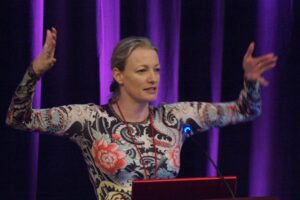
Well, after a false start on Wednesday, we did manage to connect with Elizabeth on Thursday lunch-time (let’s blame that on the date line! Not the operator !). The session began with an acknowledgement of country and an introduction to Elizabeth and her contributions to Human Computer Interaction (HCI) and UX.
The fireside chat was centred around the topic of Personal Assistants – to engage participants in conversations around the who, what, when and why of them. It turned out to be a very lively discussion, kicked off by watching a video of “Jeeves”, the quintessential English butler.
Elizabeth welcomed our SIGCHI Melbourne members, and our Brisbane colleagues, and started the conversation by reflecting on notions of “personal assistants” with respect to the video, and the relationship with the notion of ASSISTANCE rather than assistant. Issues of gender and agency came out of this. Elizabeth praised the work of Yolande Strengers (a SIGCHI Melbourne member) in her latest book,“The Smart Wife”
Another notion proposed by Elizabeth was the concept of USE rather than user. And an importance of the CONTEXT within which the assistance is being proffered.
Additional discussion points and questions were posed in the chat by participants, who generously shared links and participated in side discussions. Ideas that were raised included: DPAs (Digital Personal Assistants) as more than accessibility aids; the need for assistance service providers to work to global standards; understanding liability between assistant and assisted; do we need to give up our privacy to get a personalised/predictive assistant?; learning from librarians in the need to clarify boundaries and limitations of information searches; the narrow focus on users and assistants rather that use and assistance limiting our ability to ask other questions about these technologies and their effects on the world; the ethics of DPAs representing themselves as real people (i.e. especially in interacting with third parties on our behalf); when an agent is acting in the physical and social worlds for us, then there are issues around this we need to discuss; agents need to understand requests “in context”; could DPAs eventually hinder us as we un-learn basic tasks; the rise in “digital housekeeping” with the accumulation of digital/smart tech in the home; and a lively discussion on consent and the personal data that we give away.
The following links were shared in the chat:
Project at QUT looking at family level use
Information we give away to big business
We also talked about Apple’s Knowledge Navigator proposed in 1987 as a digital personal assistant:
To round off, we side tracked onto the topic of shoes – which resulted in those of us wear Ugg boots (guiltily?) sharing them in our Zoom video, and Elizabeth sharing with the audience the amazing “White Cockatoo” shoes she bought in Melbourne on her last visit.
An enjoyable – thought provoking and enlightening – time was had by all.
Finally – I would like to thank Alison De Kruiff for being such a great assistant handling questions and video streams during the event!
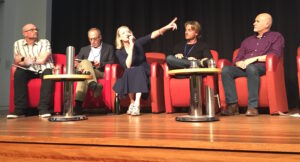
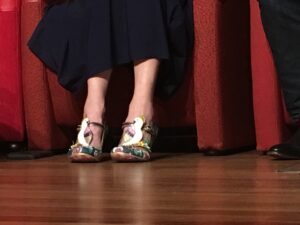
(appearance of the famous Cockatoo shoes at OZCHI 2018 in Melbourne)
Speaker Bio:
Dr Elizabeth Churchill has a background in psychology, AI, Cognitive Science, a PhD from University of Cambridge and was instrumental in building research teams at Google, eBay, Yahoo, PARC, FujiXerox. She is recognised for her contributions of HCI as a Fellow of the ACM (Association for Computing Machinery) (elected 2019), a member of ACM’s CHI Academy, the former Executive Vice President of ACM SIGCHI (2018-20), the Athena Award, for Executive Leadership, Women in Technology (2016), an Honorary DSc. University of Sussex (2018), and an Honorary Doctorate University of Stockholm (2019).
Elizabeth’s research focusses on what she calls ‘C’ technologies and situations: settings that encourage and elaborate community, communication, collaboration, coordination, consensus, competition, compassion, creativity.… and is intrigued by the artful ways that people adopt and adapt technologies into their everyday lives.